
A long time ago, in a Himalayan paradise realm far, far away, an extraordinary gathering of gods, bodhisattvas, rishis, and sages, the likes of which the universe had never seen before, came together.
They gathered within the great forests of Earth, full of medicines that can cure every disease known to humanity, to hear a four-year-long teaching given by the Buddha. This is the source code of Tibetan medicine.
Genuine Shilajit is solely Himalayan, and its roots are usually associated with Ayurveda. But it is also intimately connected with the medicine of Tibetan Buddhism. Some years ago my friend Romio Shrestha, personal artist to the Dalai Lama, introduced me to the Four Tantras, the medical paintings of Buddhism. Gazing at the first painting, I realized the fundamental relationship between Shilajit and traditional Tibetan medicine.
Sources for this post were sometimes in the original Tibetan. These texts are quite extraordinary, often highly detailed and complex, but also wonderfully expansive and inspiring. I hope that this post will give you a glimpse of the wondrous world of the Medicine Buddha – a boundless world of love and inclusivity that we never need to reach for, as we are already an expression of it.
The Coming
The Medicine Buddha
On the summit of a mountain, there exists the celestial city of Sudarshana. This is where the Medicine Buddha is recorded as having appeared to the world. This mystical paradise is surrounded by great forests of extraordinary medicine, full of potent and powerful remedies that cure all diseases known to humanity.
The Medicine Buddha came in the form of a deity, and the world simultaneously transformed into a sacred realm. By the time he had finished teaching, everything that could be known about medicine had been communicated.
Bhaishajyaguru, the Medicine Buddha, is the master of remedies and the patron deity of Tibetan medicine. He goes by many names: Vaidurya Prabha Raja, the King of Sapphire Light; Sangyé Menla – to be awakening from ignorance and being purified from darkness, opening and blossoming like a lotus flower to all that is knowable.
The Mystical Medical Paradise
Tanatuk
Tanatuk – literally “pleasing when looked upon”
a place beyond subject and object
For centuries scholars have speculated where the Medicine Buddha’s teaching happened. Some say it took place in one of the heavens, a paradise such as Trāyastrimsāa at the summit of Mount Meru, or in Akanishtha, a pure and pristine abode. As far as a physical location goes, it was possibly in Uddiyana – Northwest India or Afghanistan, the source of many diverse tantric texts and sciences.
At the center of Tanatuk is Sudarshana, the city of medicine. There are three realms to Sudarshana: the outer Sudarshana, the actual emanational or geographical location; the inner Sudarshana, the physician’s actual environment; and the secret Sudarshana, the energy inside the physician’s own body – what the texts describe as the energy centres, or chakras.
At the center of Sudarshana arises a magnificent celestial palace, made of gold, silver, white and red pearls, and beryl. It has walls constructed in five bands and battlements built of precious gemstones which, when turned into medicines, can cure all four hundred and four diseases caused by an imbalance of the three humours, and remove all the one thousand and eighty obstacles to health, fulfilling all wishes.
Standing guard at the palace gates are the four Great Kings of the cardinal directions.
The Tibetan Medical Masterpieces
The Four Tantras and the Blue Beryl
Desi Sangye Gyatso (1653-1705) was a revered confidant and adviser to the Fifth Dalai Lama. Between 1687 and 1703, he collaborated with many scholars and artists to create seventy-nine stunning paintings illustrating the Four Tantras, the teaching of the Medicine Buddha.
Simultaneously he wrote the classic Blue Beryl – 156 chapters and 5,900 verses long, covering the equivalent of some 4,800 pages – to this day the primary reference of traditional Tibetan medical knowledge. This sixteen-year project was presented to the newly enthroned Sixth Dalai Lama.
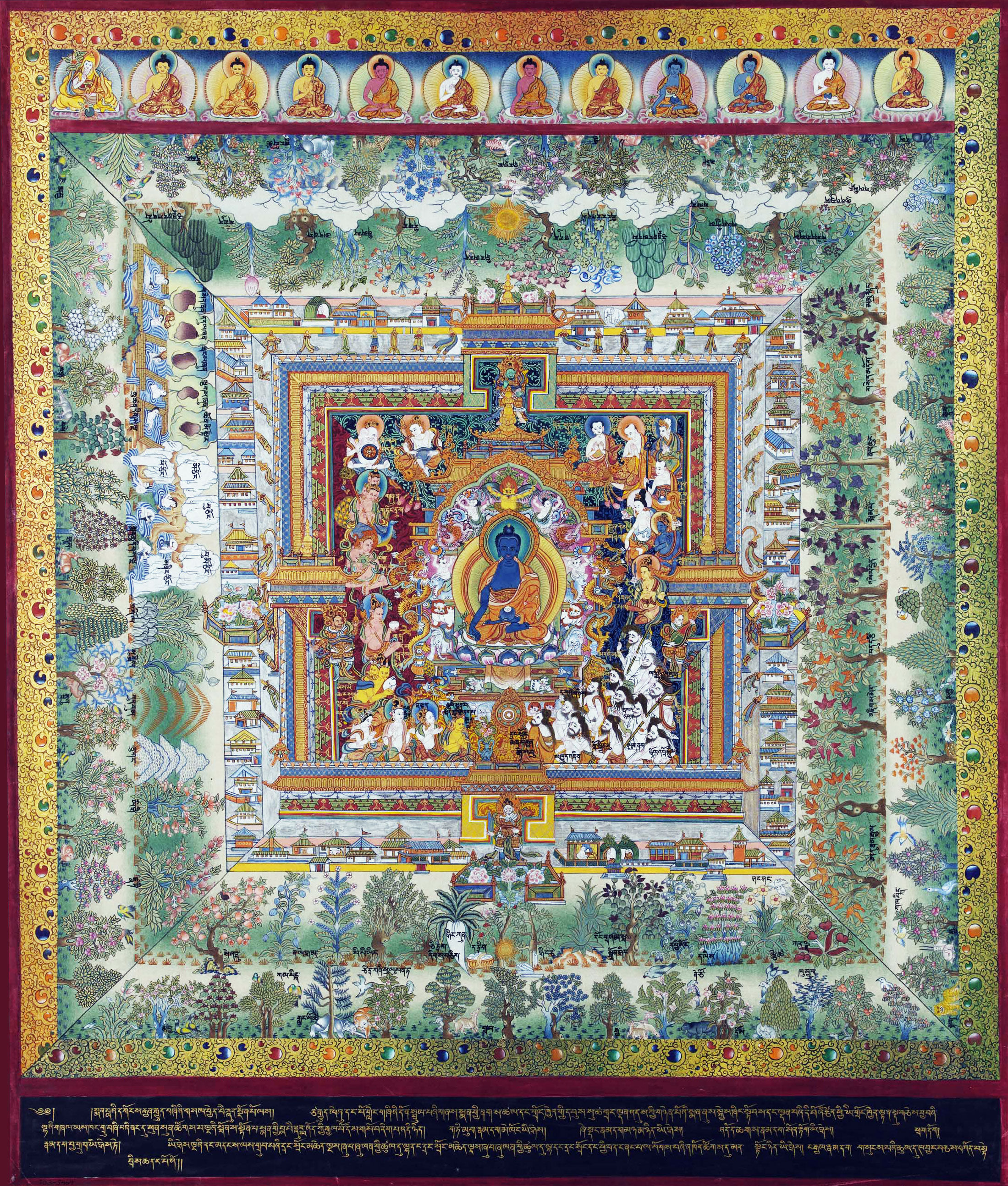
Chapter 1, First Tantra
Heavenly Abode of the Medicine Buddha Bhaisajyaguru · Recreated by Romio Shrestha and atelier
The First Painting
Heavenly Abode of the Medicine Buddha
Sitting in the centre of the palace, on an elaborate throne made of jewels – mainly white, yellow and blue beryl – is the Medicine Buddha. The throne is surrounded by lions, elephants, horses and peacocks. He sits in the luminous form of the blue emanational buddha-body, shining unimaginable rays of blue light, as vast and endless as the sky. These brilliant rays dispel the gloom of ignorance, anger and desire, and cure all physical ailments.
His right hand is turned outwards, signifying abundant generosity, holding the fruit and stem of the myrobalan plant, the universal panacea. His left hand holds a begging bowl containing nectar that cures diseases, restores the dead to life and prevents ageing.
The teaching takes the form of a dialogue between his emanation as the five hermit sages, embodying the purification and transmutation of the five poisons into the natural glow of the five pristine cognitions.1
Gods, Divinities, Bodhisattvas and Sages
The Four Retinues
As the emanational forms of Vidyajnana, the five tones of gnosis, he simultaneously explains the science of medicine to four different retinues of revered beings.2 3 4 5
The Gods of Devaloka sit in the lower left – the original transmitters of the ancient medical science. In the top left are the Hindu gods, Brahma, Shiva, Vishnu, Kartikeya, Ganesha, and Parashu Rama. In the top right are Buddhist bodhisattvas Manjushri, Avalokiteshvara and Vajrapani, who embody discriminative awareness, compassion and power.
The lower right is occupied by the great hermit sages, human and divine, who received the science of Ayurveda from Indra’s disciple Atreya – legendary for their ascetic feats.

The upper lineage row – the Fifth Dalai Lama, the eight Medicine Buddhas, and the three emanational hermit sages
Along the very top row of the painting is the lineage of medical teaching. From left to right we see the Fifth Dalai Lama (1617-82), followed by the eight Medicine Buddhas,6 and three emanational hermit sages known as Vidyajnana, representing buddha-mind, buddha-body and buddha-attributes of Bhaisajyaguru, master of remedies.
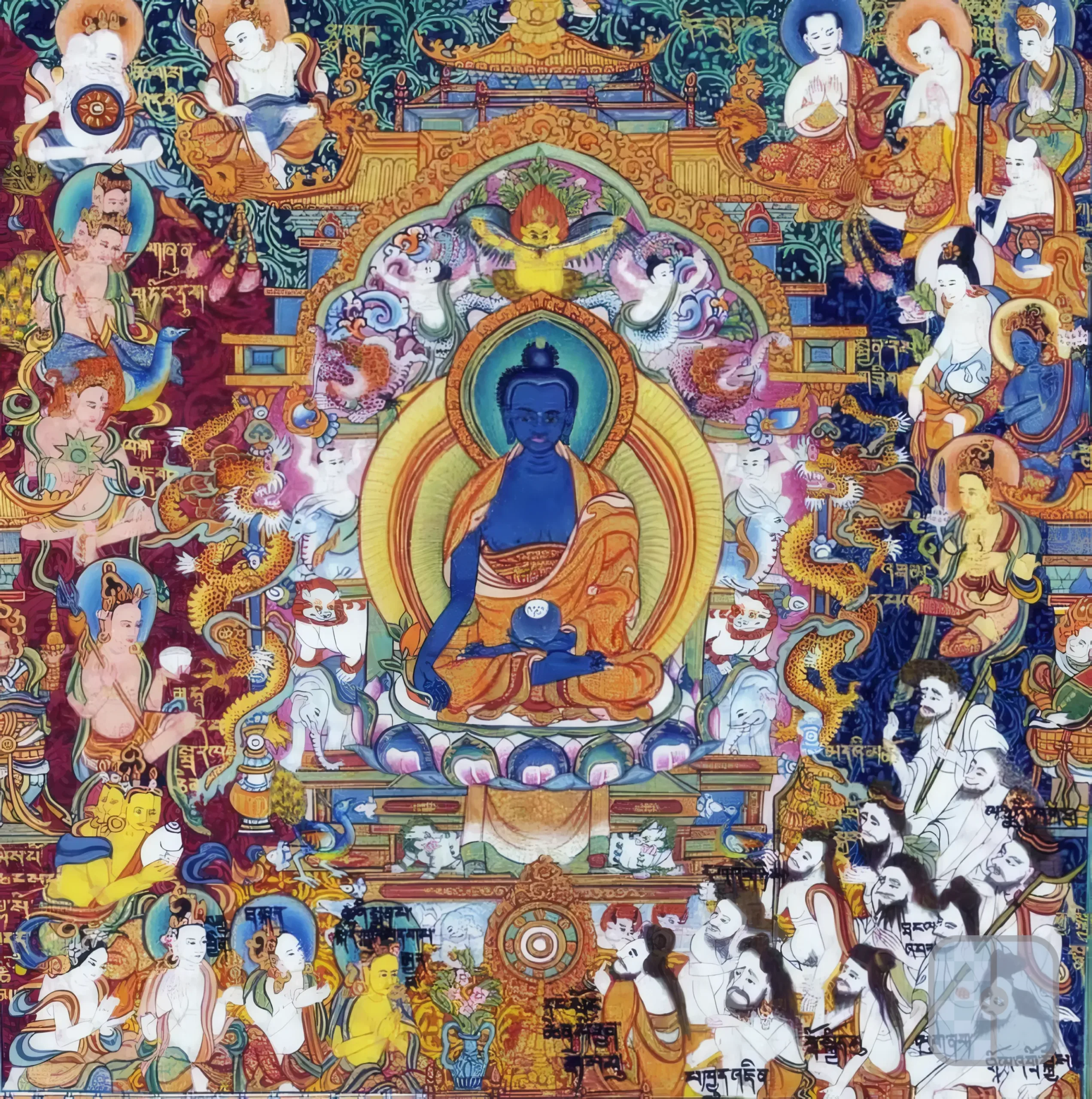
The enthroned Medicine Buddha at the centre of Sudarshana
As the Medicine Buddha spoke, two sages appeared from within him. From his heart appeared the sage Rigpai Yeshe, and from his tongue emerged the sage Yilay Kye. They entered into a fruitful dialogue.
The Buddhist texts say that only Yilay Kye understood the entire teaching – the gods, rishis and other attendees understanding each to the level of their abilities and comprehension.
The gods perceived the teachings as the Hundred Thousand Verses of Medical Therapy, the hermit sages as the Eight Sections of Caraka, the Hindu divinities as the Tantra of Black Isvara. He wrote the teachings on gold with ink made from precious blue beryl. These gold tablets were to become the source of the Blue Beryl text of The Four Tantras.
North, South, East and West
The Great Forests of Tanatuk
Surrounding the Medicine Buddha, and all those in attendance, are the medicinal flora and fauna of the great forests, able to cure every disease.

North
Himavant – the cold snow-clad mountain of the Himalayas
Here the power of moon is strong, and medicines are cooling, possessing the fragrance and power to ameliorate fevers and diseases that are hot or warm in nature. The plants are bitter, sweet, astringent and bland.
Plants: white sandalwood, camphor, eaglewood/aloeswood, chinaberry, gentian, licorice, coleus leaves, white aconite, red sandalwood, birthwort, spleenwort, kapok stamen, calyx, corolla, and grape. Animals: hare, elephant, civamcivaka, rhinoceros, Himalayan black bear.
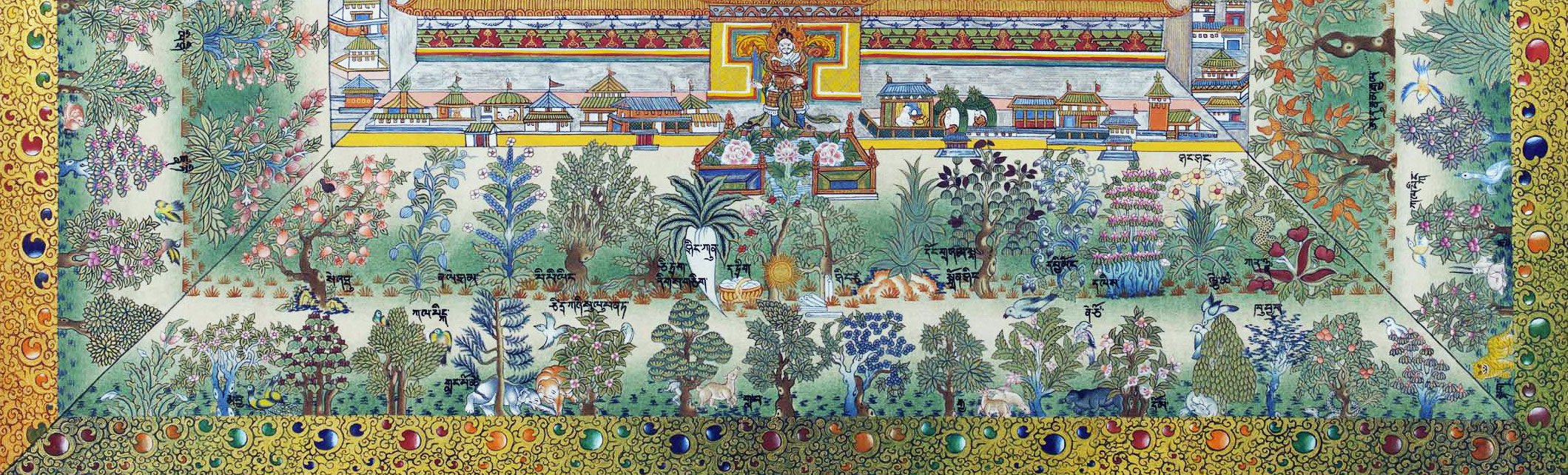
South
Vindhya – Thunderbolt Mountain, separating the Deccan Plateau from the Indo-Gangetic plains
Here the sun is strong, the plant medicine grows hot and removes cold diseases from the body. The plants are hot, sour and salty.
Plants: pomegranate, black pepper, long pepper, capsicum, asafoetida, sumac, cinnamon, cassia or ginger, pine tree-trunk, clematis, rhododendron, buttercup, civamcivaka, bonducella fruit. Animals: peacock, sparrow, elephant, musk deer, saiga antelope, parrot, Himalayan black bear, cuckoo.

East
Gandhamadana – Fragrant Mountain, ‘intoxicating fragrance’
Equally endowed with the powers of sun and moon. Flourishing here are eight species of chebulic myrobalan.7 Tibetan physicians call myrobalan the King of Medicines – it is the fruit of immortality held in the bowl of the Medicine Buddha. It has all the six tastes and eight powers of Tibetan medicine, and its perfume alone heals all four hundred and four diseases.
Animals: tiger, saiga antelope, sparrow, peacock.
West
Cool Mountain
In the West rises Cool Mountain – today considered one of the hottest hotspots of biological diversity in the world. Here grow the Six Good Things, said to simply bring happiness to all people: nutmeg, clove, bamboo pith, saffron, cardamom, cubeb. These six treat wind, heart, lungs, liver, kidneys and spleen respectively.
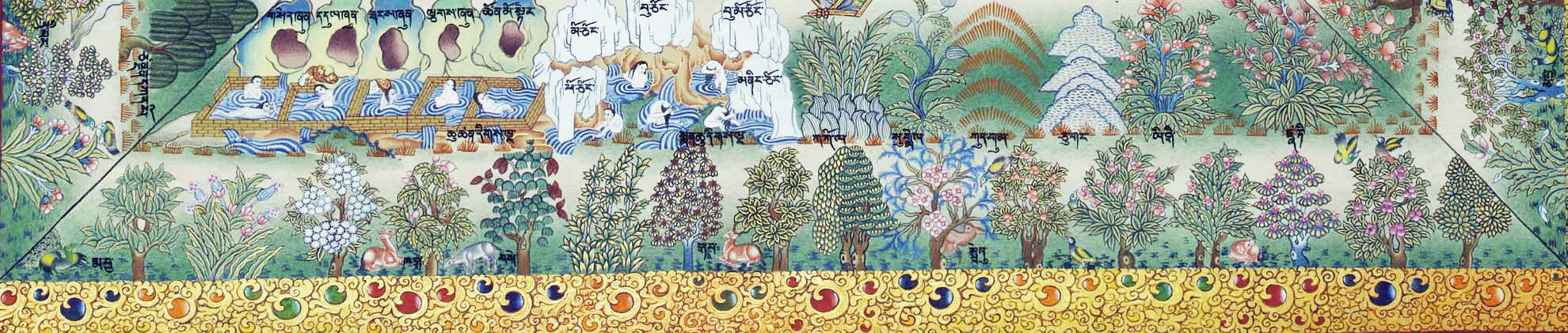
The Western Malaya – Cool Mountain. Here lie the five medicinal springs.
The Five Shilajit Springs
On closer inspection of the image below, the western quadrant shows five types of limestone8 and five medicinal springs – and five darker areas, the source of these springs. People can be seen bathing in these five medicinal pools to restore health. The flows originate from subterranean rocks which ignite on contact with water and are said to cure disorders of all three humours since they are equally cooling and warming. If these springs also contain deposits of calcite and sulphur, they respectively alleviate diseases caused by heat and cold. Each darker area has a description in Tibetan.
Correctly translated, these five medicinal springs were identified as being sourced by five different types of Shilajit – and confirmed by the Blue Beryl.
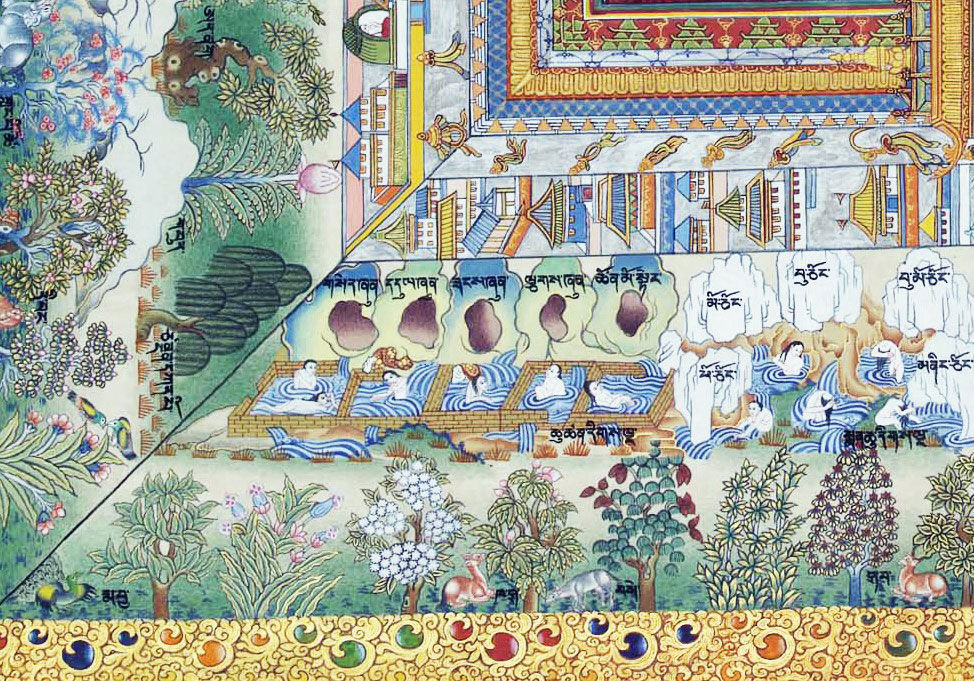
The five dark areas of the western quadrant – the five types of Shilajit, confirmed by the Blue Beryl
The Blue Beryl
Five Types of Shilajit
As translated from the original Tibetan in the Blue Beryl
lcags zhun
What we collect
Iron Shilajit
Black colour, bitter and slightly salty taste, hot and sharp potency. The Ayurvedic masters of India are in complete agreement with Tibetan knowledge on its primacy.
gser zhun
Gold Shilajit
Reddish-yellow colour, sweet-bitter taste. Cooling and oily potency, it cures conditions of air and bile.
dngul zhun
Silver Shilajit
White colour, bitter-sweet taste. Cooling and dry potency, it cures serum disorders such as leprosy.
zangs zhun
Copper Shilajit
Reddish-green colour like a peacock’s neck. Bitter and salty taste, cooling and light potency, it cures disorders of phlegm and bile.
tshon mo steng
Dark Lead Shilajit
Having the same taste and potency as iron bitumen but less effective.
The curative properties of each can only be fully understood within the full context of the Blue Beryl and with medical expertise, and are not limited to just the conditions stated above.

Pure Shilajit · Iron Shilajit · lcags zhun
What We Collect
We only collect the very finest grade of Shilajit which, according to the above categories, is Iron Shilajit. It has to come from only the highest quality of iron-rich raw Shilajit exudate. The Ayurvedic masters of India are in complete agreement with this Tibetan knowledge, as the paradise of Tanatuk contains the seed of both Tibetan medicine and Ayurvedic medicine.
Raw Shilajit collected from the best Himalayan locations, purified using the correct method that includes the synergy of medicinal herbs and processing temperatures, processing times and heat sources – this is the only proven method to transform raw Shilajit into the legendary natural panacea.
Pure Shilajit Himalaya
Acknowledgement
A sincere thank you to my friend Romio Shrestha, the personal artist to the Dalai Lama, for personally introducing me to the Four Tantras. At the age of six, Romio was recognized by Buddhist lamas to be the seventeenth reincarnation of the master Tibetan thangka painter Arniko. In the 1980s and 90s, Romio and his team were commissioned to create a new set of the Four Tantras as close to exact recreations of the 17th-century originals as is possible. In 2011 they were exhibited at the American Museum of Natural History under the title Body and Spirit: Tibetan Medical Paintings. The entire collection is now permanently housed in the museum’s Division of Anthropology.
Notes
1 The five cognitions: the mirror-like pristine cognition that defies delusion; the pristine cognition of emptiness that defies hatred; the pristine cognition of sameness that defies pride; the pristine cognition of discernment that purifies desire; and the pristine cognition of accomplishment that purifies envy.
2 Gods: Prajapatidaksha, physician of the gods, Ashvinikumarau, Indrashakra, and Amritadevi or Hariti.
3 Hindu gods: Brahma, Shiva, Vishnu, Shadanana Kumara, Ganesha, and Parashu Rama – the sixth avatar of Vishnu.
4 Buddhist Bodhisattvas: Manjushrikumarabhuta, Avalokiteshvara, Vajrapani, Ananda, Jivakakumarabhrita, Kashyapa, and Upali.
5 Hermit sages: Carakaparivrajika, Jatukarna, Ksharapani, Parashara, Punarvasu (Atreya), Dhanvantari, Bharadvaja, Agnivesha, Atreya, Aurabhra, Nimndhara, Kashyapa and Aurabhra.
6 Sunamaparikirtana, Svaraghosharaja, Suvarnadhadravimala, Ashokottama, Dharmakirtisagaraghosha, Abhijnaraja, Shakyaketu and Bhaishajyaguruvaiduyaprabha.
7 Victorious myrobalan, fearless myrobalan, nectar myrobalan, enriching myrobalan, dry myrobalan, small black myrobalan, golden colored myrobalan, and beak-shaped myrobalan.
8 Neuter limestone (gypsum), girl limestone, boy limestone, female limestone, male limestone.
Bibliography
The Blue Beryl, Desi Sangye Gyatso
The Mirror of Beryl, Desi Sangye Gyatso
Tibetan Medical Paintings, Gyurme Dorje
Original selected thangkas painted by Romio Shrestha and atelier
All content copyright ©2017 Daniel Burge and Pure Shilajit. Not to be reproduced without prior permission of the author.